
ChatGPT has drastically changed workflows across almost every industry. Where earlier it used to take hours of brainstorming, researching, or verifying, now it gets done with only a set of explicit instructions, and there you go. In fact, many people today barely type a sentence, unless ChatGPT gives a heads up. And there’s nothing wrong in doing so. When change calls, you answer it. Bloggers, freelancers, students, SEO agencies, affiliate marketers, and business owners push AI for writing because it saves time. One prompt gives a full draft in seconds. It’s amazing, the age of AI.
What’s the Catch?

Most AI writing sounds robotic. And no wonder, robots are not meant to write a polished version of what you want. Instead, they are researchers. They gather information and give you a draft to give you a head start.
What happens on using that very same draft by AI that detectors flag it and editors tend to it. Also, most importantly, Google users bounce off the page after reading only a paragraph or two. This pushed many writers into one big question: How to humanize AI content?
How to Humanize AI Content?
There was a time when I faced the same issue. My early AI articles looked overly polished, and were extremely lifeless. It forced me to change my process. And now the case is such that my AI-assisted blogs pass many AI detection tools with near zero AI score. Moreover, readers enjoy reading them as they find them relatable.
1. I Never Let ChatGPT Write the Final Draft
This is the biggest mistake people make with AI writing tools. They open ChatGPT, type a prompt, copy the answer, and publish it directly. That approach fails badly. AI gives predictable sentence structures. It repeats patterns. It uses robotic transitions. Readers can figure this out instantly because it doesn’t sound natural.
What I do is that I do not treat AI like a writer, but an assistant. I use it for:
- research direction
- topic ideas
- structure
- rough points
- missing information
- headline variations
After that, I rewrite heavily. And this step changes everything.
2. I Write Like I Speak
We do not write essays anymore after school. But AI written content traces back to that time of our life. Humans don’t speak like that. They write, they halt and switch tones. People use small reactions, throw short lines in between. That’s the reason I intentionally write in a conversational rhythm. For example:
Instead of:
“This strategy provides excellent results for content optimization.”
I write:
“This trick worked surprisingly well for me.”
Spot the difference? One sounds corporate, and the other sounds naturally human. This matters a lot if you want to humanize AI content.
3. I Remove AI Favourite Words Aggressively
AI tools like ChatGPT love certain words. After reading enough AI blogs, you start spotting them immediately.
Words like:
- delve
- furthermore
- transformative
- revolutionary
- leverage
- robust
- seamless
- comprehensive
- instantly
People don’t normally use these words in casual writing. I manually remove them after drafting. This improves readability and your AI score right away.
4. Avoid Long Sentences
Extra-long sentences can definitely make your content score very high when detected. If you write shorter sentences, it improves the readability, and you can check it by putting it on Hemingway. What I do is:
- I use shorter fragments,
- start sentences with “And” (sometimes), &
- use uneven paragraph sizes.
Example:
“And then? Then, it turned out to be terrible in the end.”
The line above sounds natural because humans actually talk like that.
5. Add Your Personal Experiences Everywhere
AI isn’t aware of your personal moments. And this is what you can use as an opportunity to add what’s missing and humanize the content. Because humans can.
So I insert:
- mistakes I made
- client feedback
- publishing failures
- traffic drops
- funny incidents,
- and other relevant moments.
6. I Never Trust One AI Detector

Many people panic after seeing a 70% AI score. AI detectors contradict each other constantly. This step may not hold as much value as the others, but it is important to know too, because detectors scan patterns.
A 2023 study from Stanford University found that several AI detectors incorrectly flagged human-written content too. Therefore, my end goal is chasing readability and engagement with my article over chasing the detector perfection alone.
7. My Editing Process Matters More Than My Prompt
People search endlessly for the perfect prompt for ChatGPT and other AI writing tools. But prompts alone won’t save robotic writing. Editing matters far more. My process looks like this:
Step 1: Use AI for rough research
I use ChatGPT deep research for:
- topic understanding
- FAQs
- missing angles
- common search intent
- competitor topic ideas
Step 2: Rewrite manually
I completely reshape:
- introductions
- examples
- transitions
- storytelling
- opinions
Step 3: Read aloud
This trick works insanely well. If a sentence sounds robotic while you’re reading it aloud, readers will notice it too. I cut those lines immediately.
Step 4: Reduce repetitive structure
AI repeats:
- sentence length
- formatting rhythm
- transition patterns
I deliberately ignore that pattern. That makes the article sound more human.
ChatGPT New Trend Prompt
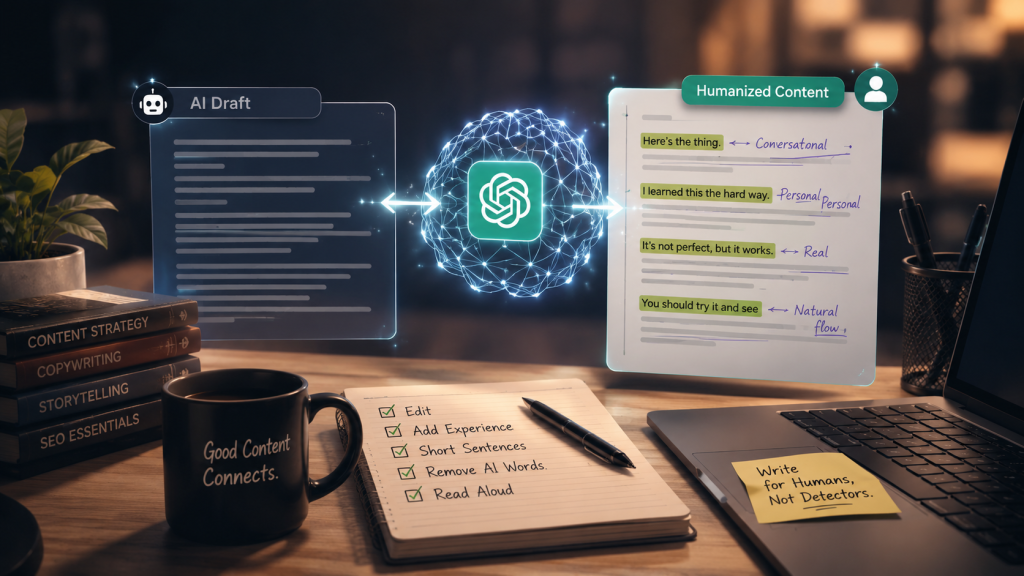
Many creators now use what social media calls the ChatGPT new trend prompt. These prompts tell AI:
- “Write like a human”
- “Avoid AI tone”
- “Use conversational language”
- “Sound natural”
Some prompts help slightly. No prompt alone produces fully human writing. You would need to edit it manually. A strong and explicit ChatGPT prompt gives a better starting point.
8. I Mix Human Research with AI Research
I don’t depend fully on AI for writing research.
I also:
- read Reddit discussions
- check Quora threads
- scan YouTube comments
- read real customer reviews
- observe LinkedIn conversations
Real people use viral, trending and unpredictable language. AI cannot fully imitate that randomness yet. Human input advances writing quality massively.
9. I Cut Fluffy Introductions
We all know how AI loves long introductions. And on the contrary, humans hate waiting. Already being aware of this useful information, I choose to enter the topic quickly. It gives way to better retention.
It is smart to use a hook in the introductory paragraph. A great hook with the topic itself is capable of engaging the reader for long.
How to Use ChatGPT Effectively for Writing?
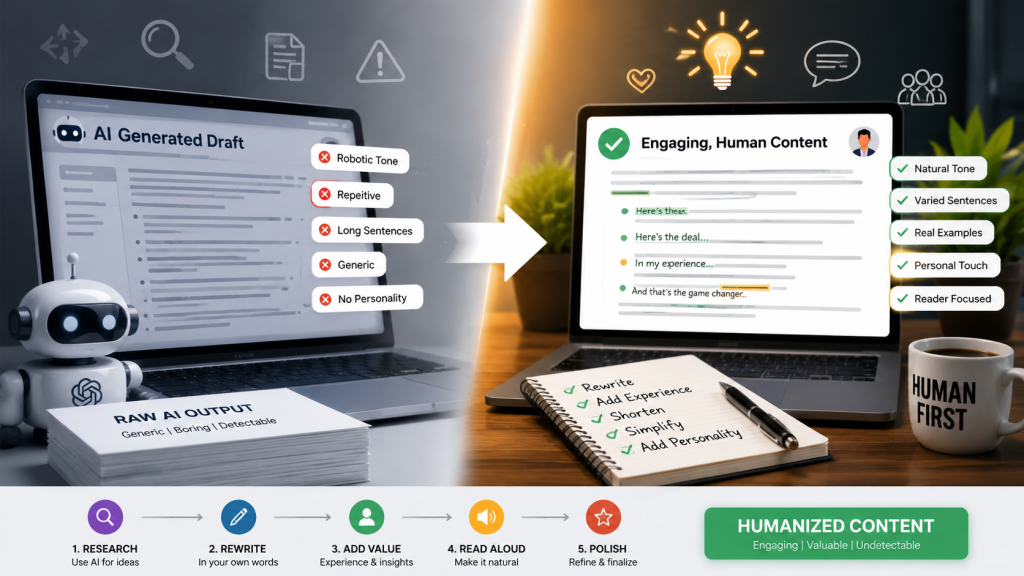
If you really want good AI-assisted content, follow this mindset:
Don’t ask AI to write the article
Ask AI to:
- brainstorm
- structure
- simplify
- summarize
- research
- expand ideas
Then you shape the article yourself. That’s the smartest way to use AI for writing right now.
My Favourite Use Cases for ChatGPT
I personally use ChatGPT for:
- blog outlines
- title ideas
- FAQ generation
- SEO topic clustering
- rewriting awkward lines
- simplifying technical topics
- generating meta descriptions
- content gap research
It saves hours when used properly.
Do You Feel Ready to Produce AI-Free Content Using ChatGPT?
There’s no shortcut or trick to humanize AI content. Humanized content comes from:
- rewriting
- storytelling
- personal input
- unpredictable structure
- conversational rhythm
- real editing
AI tools like ChatGPT can speed up writing heavily. But raw AI output nonetheless sounds repetitive in many cases. You, as a writer, can fix that problem yourself. That’s why two people using the same prompt produce completely different articles.