
Table of Contents
Every day you go to your dressing table, morning and night. At times, what ails it gets to you more than you think: a mirror which is placed too high, a drawer which won’t quite shut, a corner which is always in shadow. For the most part, the issue isn’t with the design at all. It’s that one small planning mistake which was made early on.
What are the common dressing table design mistakes?
Here are ten mistakes that quietly ruin a dressing table, and how to fix each one before or after installation.
1. Not Measuring the Wall First
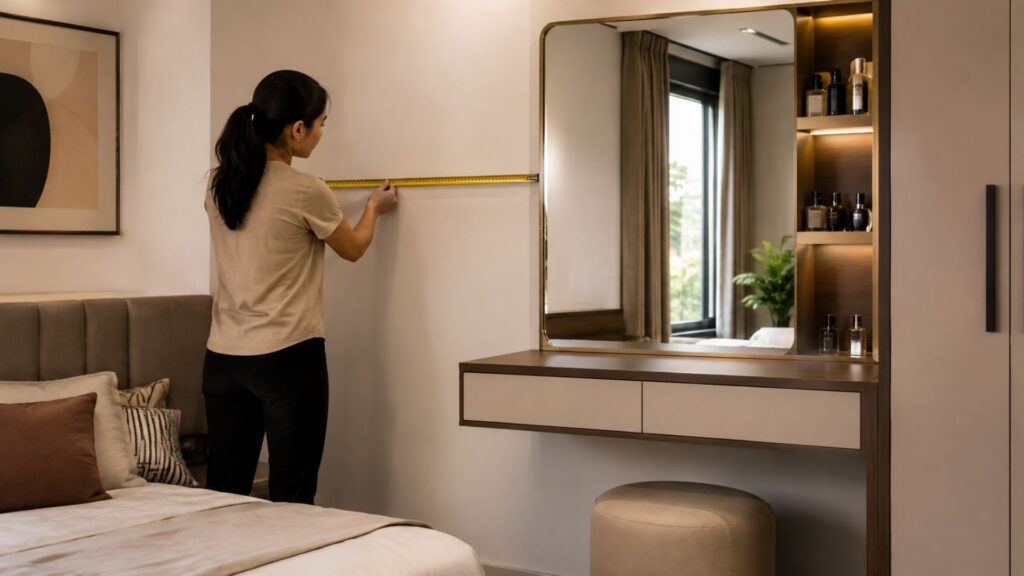
Homeowners often pick a dressing table design from a photo online, then try to fit it into their bedroom afterwards. The counter ends up too wide for the wall, or the mirror hits the ceiling line at an odd point.
How to fix it?
Measure the wall width, the depth available, and the ceiling height before you finalise any design. Then check the table’s dimensions against that measurement, not the other way around.
2. Buying a Dressing Table Too Big for the Room
How to fix it?
Pick a compact or wall-mounted dressing table for rooms under 100 sq ft. A 450mm–500mm wide counter holds a mirror and two drawers without taking over the room.
3. Blocking the Wardrobe Door or the Window
How to fix it?
Plan the dressing table and wardrobe together, not as separate purchases. If the wardrobe has a hinged door, leave its full swing radius clear before you decide where the table goes.
4. Picking a Mirror That Doesn't Match Your Height
How to fix it?
Set the mirror’s centre point roughly at eye level for the main user while seated on the stool. A stool height of around 450mm usually puts the mirror centre near 950mm–1000mm from the floor.
5. Ignoring Where the Light Comes From
How to fix it?
Add side lighting or an LED strip around the mirror edge instead of relying on the ceiling light alone. Warm or neutral white light works better than a cool blue tone for this.
6. Cramming in Too Many Drawers
How to fix it?
List out what you’ll store- makeup, jewellery, daily accessories- before finalising the drawer count. Two to three well-sized drawers usually cover it for one person.
You Must Read: 12 Bedroom Corner Ideas to Utilise Unused Space
7. Using the Wrong Material for the Room
How to fix it?
Pick BWR-grade plywood or solid wood for rooms with higher humidity. Save MDF for dry rooms or lower-budget projects where a shorter lifespan is an acceptable trade-off.
8. No Clearance for the Stool
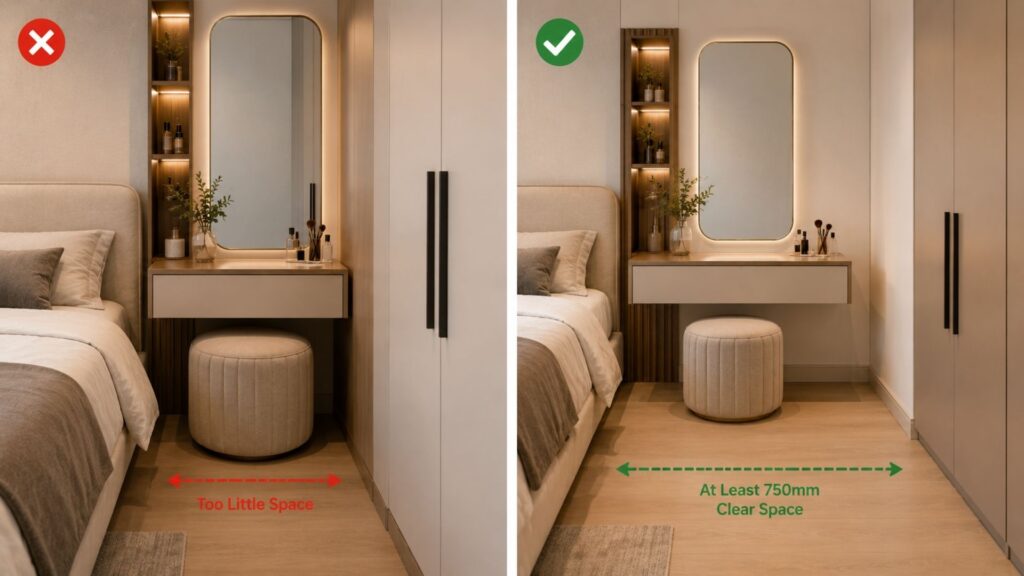
How to fix it?
Leave at least 750mm of clear space in front of the counter for the stool and for standing up without hitting nearby furniture.
9. Forgetting an Electrical Point
How to fix it?
Mark the electrical point on the layout before installation starts, not after. This matters even more for wall-mounted units, where retrofitting a socket later means breaking into the wall.
10. Placing It in the Wrong Spot in the Room
How to fix it?
Place the dressing table where it gets natural light during the day and doesn’t interrupt the main walking path. A spot near the window, or built into the wardrobe run, usually works better than a random corner.
How to Avoid Common Dressing Table Design Mistakes
Before you buy your dressing table, measure the room out, plan it in with your wardrobe, check the mirror height, and see that lighting and electrical outlets are in place. By getting these details at the very beginning, you will avoid costly changes down the road.