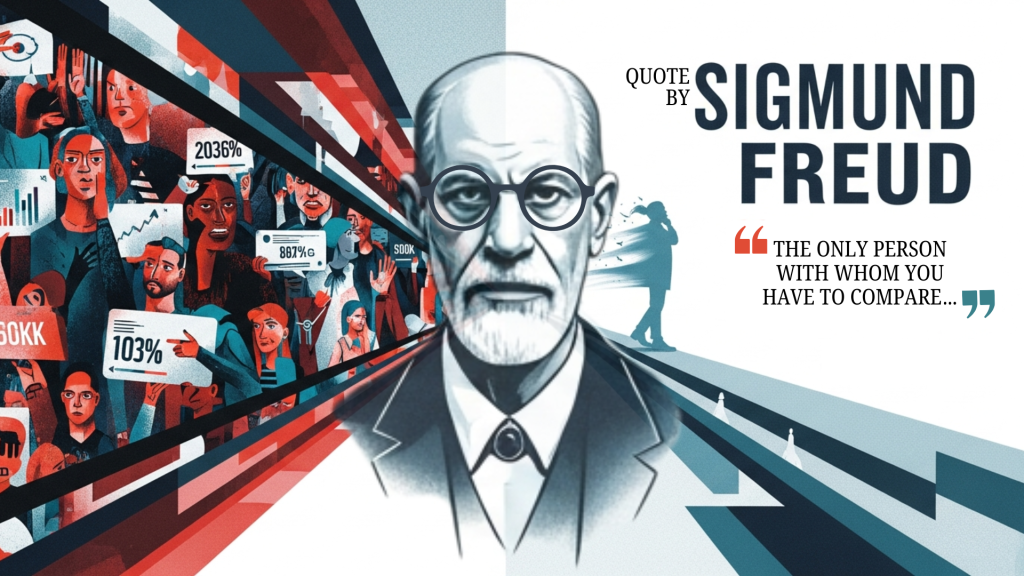
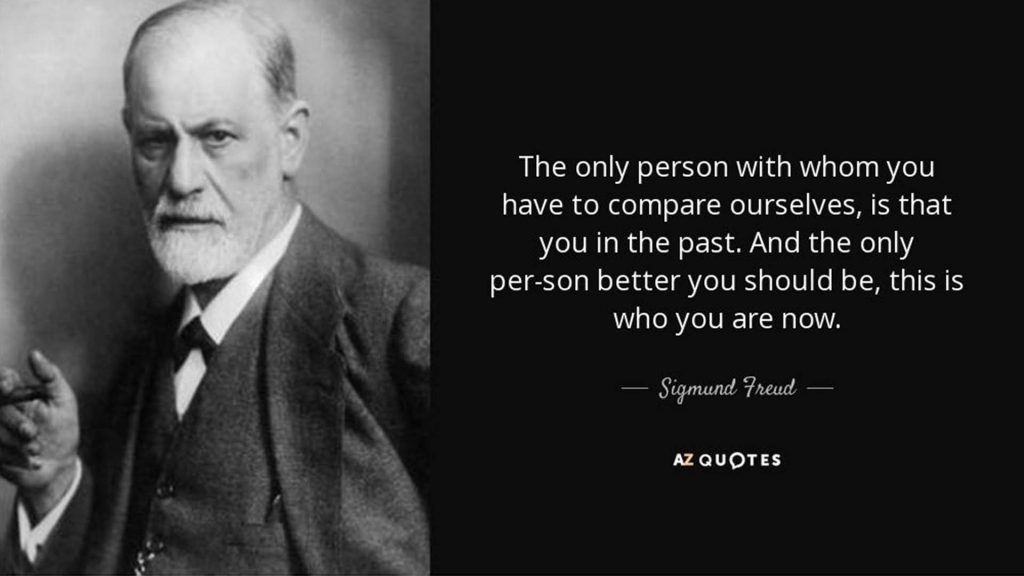
Sigmund Freud, the pioneering Austrian neurologist who founded psychoanalysis, irrevocably changed how we understand the human mind. His theories on the unconscious, dreams, and the dynamics of the id, ego, and superego, though debated, laid the groundwork for modern psychology by insisting that our present is shaped by our past. So, it makes sense that a helpful piece of advice connected to his work would encourage us to look inward. That advice is, “The only person you need to compare yourself to is who you were yesterday.” Although the exact quote may be a paraphrase of his core ideas, its sentiment is deeply rooted in his understanding of the individual’s psychic journey. More than a simple motivational saying, this principle delivers a scientifically sound strategy for fostering resilience, intrinsic motivation, and a healthier sense of self.
Trap of Social Comparison
To appreciate the value of Freud’s proposed framework, we must first acknowledge the psychological toll of its opposite. We live in an age of constant benchmarking. Social media platforms are engineered to highlight reels, professional environments often emphasize ranking, and advertising thrives on creating aspirational insecurities. This fuels what psychologist Leon Festinger formally outlined in his 1954 Social Comparison Theory, the innate human drive to evaluate oneself through comparison with others.
While this can sometimes provide useful information, the modern scale of comparison is unprecedented and largely unhealthy. Engaging in frequent upward social comparison, measuring ourselves against those we perceive as more successful, attractive, or accomplished, is strongly linked in research to increased levels of anxiety, depression, and diminished self-esteem. The problem is that the benchmark is external, unstable, and often an illusion. We compare our internal, complex reality, with all its private struggles and doubts, to the curated, external presentation of others. This creates a moving goalpost of satisfaction, guaranteeing we never truly arrive.
The Internal Yardstick for Sustainable Growth

Shifting focus from others to ‘you in the past’ is not an exercise in self-indulgence. It is a method of establishing a personal, contextual, and fair metric. This internal comparison aligns with several evidence-based psychological benefits:
It Cultivates Intrinsic Motivation: When your benchmark is your own previous performance, the drive to improve comes from within. You are no longer trying to beat someone else for external validation, but rather to master a skill, deepen an understanding, or build a better habit for your own sake. Decades of research in motivational psychology confirm that intrinsic motivation is far more durable and leads to greater satisfaction and creativity than extrinsic motivation driven by competition or fear.
It Enables Nuanced and Compassionate Measurement: Your past self is a known entity. You understand the specific challenges, resources, and mental states you were navigating. Comparing that version allows for kinder, more insightful questions: Am I responding to stress with more resilience than I was a year ago? Has my understanding of this issue become more nuanced? Is my internal dialogue more compassionate? These qualitative measures of growth are often more meaningful than any numerical rank. This practice is the cornerstone of self-compassion, a trait psychologist Kristin Neff has rigorously linked to greater emotional resilience and reduced anxiety.
It Increases Agency and Reduces Anxiety: The accomplishments and journeys of others are largely outside your control. Fixating on them breeds a sense of powerlessness and anxiety. Your own trajectory, however, is a domain where you have direct, though not absolute, influence. By focusing on your own progress, you reinforce your sense of agency, the belief that your actions can effect meaningful change in your life. This shift from an external to an internal locus of control is a key factor in mental well-being.
Would You Like to Apply this Principle?

Adopting this mindset requires moving from theory to practice. It does not mean rejecting all competition or ignoring external standards, but rather making your personal growth the primary metric.
Maintain a Regular Journal: The single most effective tool for tracking your past self is a written record. Journaling creates a tangible archive of your thoughts, challenges, and perspectives. Reviewing entries from six months or a year prior provides an unvarnished and often surprising window into your personal evolution.
Conduct Reflective Reviews: Periodically, set aside time for a formal review. Ask specific, non-judgmental questions: What have I learned in the last quarter that I didn’t know before? What emotional trigger do I now handle better? How has my approach to problem-solving changed? Focus on progress, not perfection.
Reframe Goal Setting: Structure personal objectives around self-mastery. Instead of “I want to be the top performer,” consider “I aim to improve my efficiency or technical skill relative to my own baseline from last year.”
Begin Now
In essence, the enduring wisdom in this Freud-inspired idea is its strategic redirection of energy. It moves us from the exhausting, demoralizing arena of external comparison to the fertile ground of internal development. By making our past self our primary reference point, we are not lowering our standards. We are personalizing them, creating a benchmark that is challenging and achievable. It is a practice that honours the uniqueness of our individual journey and allows us to measure success not by the distance we have put between ourselves and others, but by the distance we have travelled from our own starting point. That is the only progress that is truly, undeniably, ours.